

Hiring a financial advisor is a strange kind of shopping. So people default to vibes. Somebody they trust makes a recommendation, the meeting goes well, the person seems sharp, paperwork gets signed. Eight months later, they could not tell you what the fee covers, and now asking feels weird.
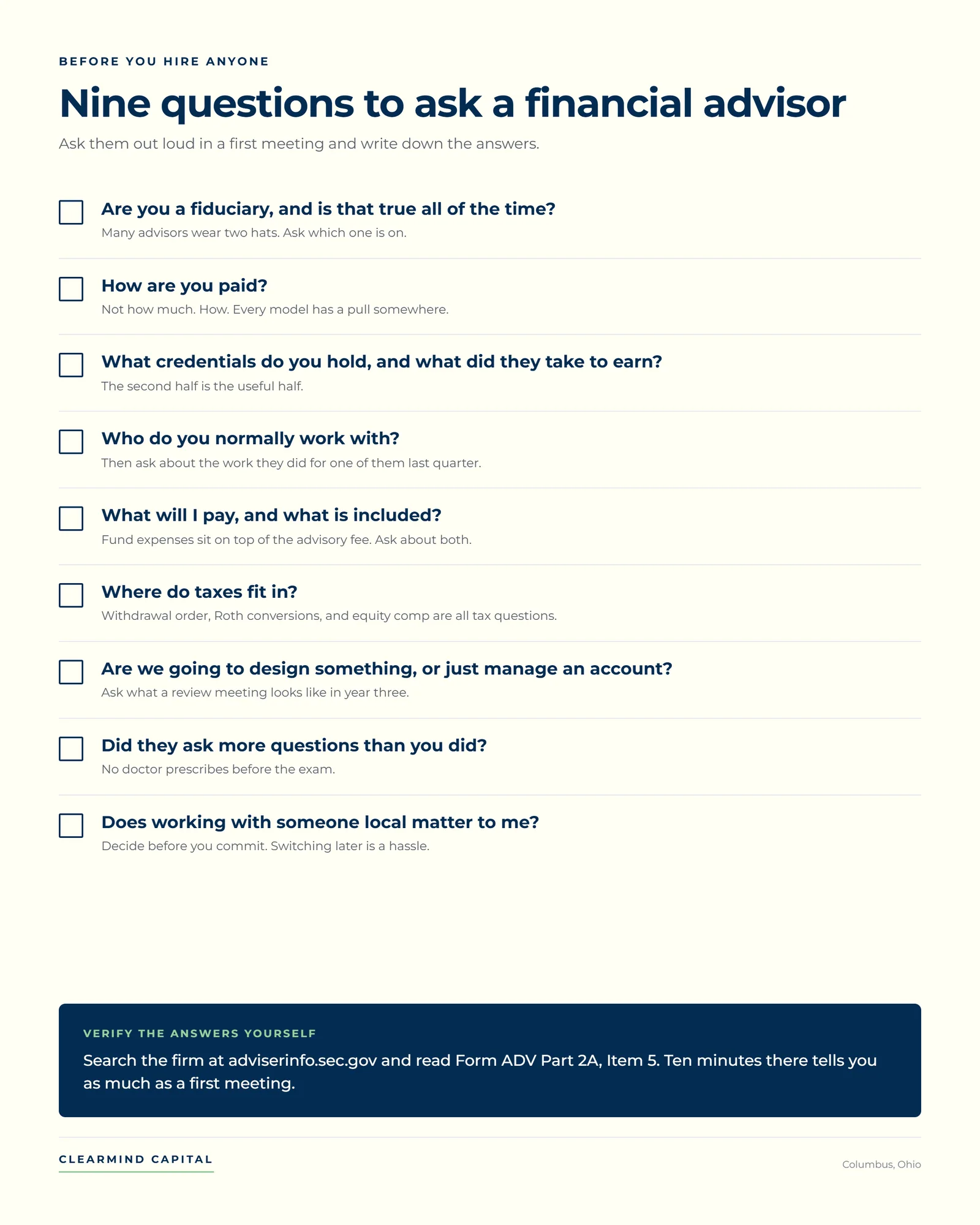
These nine questions fix that. None of them require you to know anything about the industry. Go on and stick them in your back pocket:
1. Are you a fiduciary, and is that true all of the time?
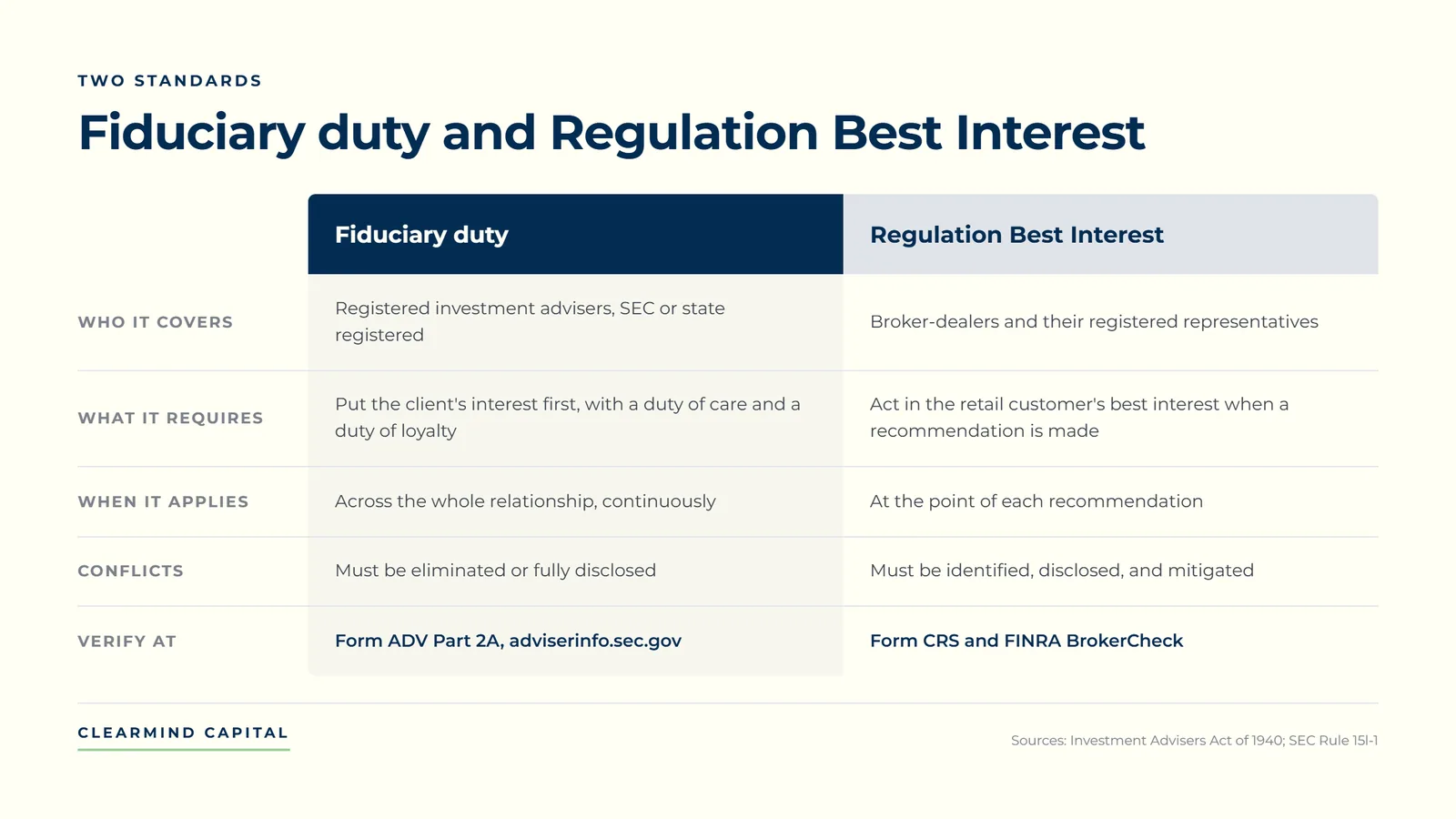
A fiduciary is legally required to put your interest ahead of their own. That sounds like the floor for financial advice, and it is not the standard that everyone giving financial advice is held to.
Registered investment advisers, meaning firms registered with the SEC or with a state securities regulator, owe you that duty. Brokers work under a rule called Regulation Best Interest, which requires them to act in your best interest at the moment they make a recommendation. It is a real standard. It applies transaction by transaction rather than continuously, which is the practical difference.
Now plenty of good advisors wear two hats. Fiduciary when managing your portfolio, insurance agent when placing a policy, sometimes in the same meeting. That is legal, common, and disclosed. It is also something you want to know about before the second hat comes out, so just ask.
2. How are you paid?
How vs. how much matters here. This is the "how."
Glossary of Financial ClarityFee-onlyAn advisor who only gets paid by you, never by commissions for selling you products. It removes the quiet incentive to nudge you toward whatever pays them the most. You know exactly who's writing their check: you.General education only. Not tax or investment advice. See the full glossary means clients are the only source of income. Fee-based means client fees plus commissions on certain products. Commission-based means the product companies pay and you do not write a check.
All three exist for reasons, and all three have a pull in them somewhere. An advisor paid on assets has a reason to prefer that your money stay invested with them. An advisor paid on commission has a reason to prefer the product. Neither of those makes anyone a villain. It makes the question worth asking out loud so you can weigh the advice knowing where it is coming from. Fee-Only vs. Fee-Based vs. Commission
3. What credentials do you hold, and what did they take to earn?
The second half of that question is the useful half. This industry has a lot of letters... like a lot.
The Glossary of Financial ClarityCertified Financial Planner (CFP®)The gold-standard credential in financial planning. Earning it takes a college degree, a stack of required coursework, a famously tough exam, thousands of hours of real experience, and a signed commitment to act as a fiduciary. Our founder, Nick George, holds it.General education only. Not tax or investment advice. Read the full story certification is the broadest recognized credential for comprehensive planning: a college-level curriculum, a six-hour board exam, thousands of hours of documented experience, a background review, and continuing education forever. CFP® professionals are also held to a fiduciary duty by CFP Board whenever they give financial advice. A Glossary of Financial ClarityCPAA CPA, or certified public accountant, is an accountant who has passed a demanding licensing exam and met state experience requirements. Not everyone who does taxes holds the license, and it lets them do things an unlicensed preparer can't, like represent you in front of the IRS and sign off on audited financial statements.General education only. Not tax or investment advice. Read the full story matters when your situation is tax-heavy. A CFA points toward investment analysis.
If you see letters you do not recognize, look them up. It takes two minutes and the requirements are public. Some designations represent years of work and some represent a weekend and a fee, and you cannot tell them apart by how impressive they look on a business card.
4. Who do you normally work with?
An advisor who spends every week sequencing retirement withdrawals is solving a different puzzle than one who spends every week on equity compensation for people in their forties. Both can be excellent. Only one of them has seen your exact situation fifty times.
Ask who their typical client is, then ask them to describe the work they did for one of them last quarter. Someone with a real focus will light up and get specific. That energy is a good signal on its own.
5. What will I pay, and what is included?
Two halves here.
On cost, you want to understand the fee schedule and roughly what it means for a portfolio your size, plus whether the investments they use carry expenses on top of it. Fund expense ratios come out of returns rather than arriving as a bill, so they are easy to miss entirely.
On scope, you want the list. Is this investment management? Does it include a financial plan, and is that plan revisited or written once and filed? Tax projections? Insurance review? Estate coordination? A fee only means something next to the work attached to it. What Does a Financial Advisor Cost
6. Where do taxes fit in?
Investment decisions are tax decisions in a costume. Which account you draw from in retirement is a tax question. Whether to convert to Glossary of Financial ClarityRoth IRANamed after Senator William Roth, who pushed it into law in 1997. The design is clever on both ends: you pay the tax now instead of later, so the government collects its revenue up front, and in exchange your money grows and comes out completely tax-free in retirement. You put in dollars you've already been taxed on, let them grow for years, and qualified withdrawals down the road owe nothing. You're basically betting your tax rate later will be higher than it is today, which is why it tends to shine early in a career or in a low-income year.General education only. Not tax or investment advice. Read the full story this year is a tax question. When to sell vested shares is a tax question. When to claim Glossary of Financial ClaritySocial SecuritySocial Security is the federal program that sends monthly checks to retirees, along with some disabled workers and survivors. You pay into it through payroll taxes your whole working life, and what you eventually collect depends on your earnings history and the age you start claiming. For most retirees it's the one paycheck that lasts as long as they do.General education only. Not tax or investment advice. Read the full story is, mostly, a tax question.
Some advisors are hired for investments alone and do that job well. Others build the tax work into the relationship. Both arrangements are legitimate. You want to know which one you are buying, because from the outside they look identical and they are priced surprisingly close together.
A quick way to test it: ask what Ohio moving to a flat 2.75% income tax rate in 2026 changed for someone in your bracket. You are listening for whether the answer is specific.
7. Are we going to design something, or just manage an account?
Maybe the most important question? You be the judge.
There is a version of this relationship where an account gets managed competently and reported on quarterly, forever. Nothing wrong with it. There is another version where somebody sits down with you and asks what you want the next ten years to look like, listens and asks questions, and then works backward: here is what would have to be true, here is what we would change this year to start pointing that direction, here is what we revisit in twelve months.
This second version treats your money as a tool for a life you described out loud. It also means the advice changes when the vision changes, which is the point... right?
Ask what a review meeting looks like in year three. If the answer is entirely about performance against a benchmark, you have learned something useful.
8. Did they ask more questions than you did?
In a good first meeting, most of the talking is you. Unless you hate talking, then it truly might be the advisor, which is fine. But the more you talk... the better. What you are building toward, what keeps you up at night, what you have already handled, what you suspect you have missed. The advisor is mapping the situation before proposing anything.
When a recommendation arrives before the questions do, it usually means the answer was decided before you walked in. No doctor prescribes before the exam. In this business, bringing on a client might take a few months, and feeling rushed can also be a red flag.
9. Does working with someone local matter to you?
Columbus has a deep bench of independent advisors. If you want to sit across an actual table, or work with someone who knows how business gets done here, local carries real weight.
Plenty of people work happily with an advisor two time zones away and never think about it. Either is fine. Decide which one fits how you operate before you commit, because switching later is a bigger hassle than it sounds.
You can verify most of this yourself
Every registered investment adviser files a public document called Form ADV. Search the firm or the person at adviserinfo.sec.gov and open Part 2A, the brochure.
- Item 5 tells you how they charge and whether anyone else pays them.
- Item 10 lists insurance licenses and broker-dealer affiliations.
- The disclosure section on the individual's record shows regulatory and complaint history.
You can confirm a CFP® certification at letsmakeaplan.org, and FINRA's BrokerCheck covers the brokerage side.
Most advisors are trying hard to do right by the people who hired them. We are not playing "gotcha" here.
Common questions
What should I ask a financial advisor in the first meeting?
Ask whether they are a fiduciary and when that applies, how they are paid, what credentials they hold, who they typically work with, what you will pay and what is included, how tax planning fits in, and what a review meeting looks like three years in. Then notice whether they asked you more questions than you asked them.
How do I check if a financial advisor is legitimate?
Search the firm or individual at adviserinfo.sec.gov, the SEC's Investment Adviser Public Disclosure site. Read Form ADV Part 2A for fees and conflicts, and check the disclosure section for regulatory actions or customer complaints. FINRA BrokerCheck covers brokers, and CFP® certifications can be verified at letsmakeaplan.org.
What is the difference between a fiduciary and a financial advisor?
"Financial advisor" is a general job title with no single legal standard behind it. "Fiduciary" is a legal duty to act in the client's interest. Registered investment advisers owe that duty across the relationship. Brokers are held to Regulation Best Interest, which applies at the point of each recommendation.
Does a financial advisor need to be local?
No. Many people work entirely remotely with an advisor and prefer it. Local matters if you value in-person meetings, want someone familiar with the regional business community, or like knowing there is an office nearby. It is a preference question rather than a quality question.
How much should I have saved before hiring a financial advisor?
It depends on the pricing model. Advisors charging a percentage of assets often set account minimums. Advisors offering hourly, flat-fee, or starter engagements can work with people who have high income and little invested yet. If your situation is complex, the complexity matters more than the balance.

 Written byNick George & Shane DuckworthClearMind Capital · Private WealthView bio →
- SEC Investment Adviser Public Disclosure, adviserinfo.sec.gov: Form ADV Part 2A structure and content.
- Investment Advisers Act of 1940 and SEC Regulation Best Interest, Rule 15l-1.
- CFP Board: certification requirements and Code of Ethics and Standards of Conduct.
- Ohio House Bill 96 (2025): flat 2.75% state income tax rate, effective tax year 2026.
The information presented in this article is for informational purposes and should not be intended as tax, accounting or legal advice, nor is it an offer or solicitation to buy or sell, or as an endorsement of any company, security, fund, or other offering. Please consult your legal, tax, or accounting professional regarding your specific situation. Investments involve risk and have the potential for complete loss. It should not be assumed that any recommendations made will necessarily be profitable.
The opinions expressed in any commentary posted on this site are solely those of the individual author and do not necessarily reflect the views or opinions of ClearMind Capital, LLC. These opinions are based on information available at the time of posting and are subject to change without notice. ClearMind Capital, LLC, does not commit to updating any posted positions or commentary to reflect subsequent developments. While the information and reasoning used to form these opinions are believed to be from reliable sources, ClearMind Capital, LLC, does not verify this information, and no guarantee is provided regarding its accuracy, completeness, or validity. ClearMind Capital, LLC, disclaims any and all liability for actions taken or not taken based on the content of this site. No warranty, express or implied, is given in connection with the content provided.
Certified Financial Planner Board of Standards Center for Financial Planning, Inc. owns and licenses the certification marks CFP®, CERTIFIED FINANCIAL PLANNER®, and CFP® (with plaque design) in the United States to Certified Financial Planner Board of Standards, Inc., which authorizes individuals who successfully complete the organization’s initial and ongoing certification requirements to use the certification marks.


