

When an owner asks what a Glossary of Financial Clarity401(k)A retirement account through your job where money leaves your paycheck before you ever see it. If your employer matches, that match is about the closest thing to free money you'll get offered at work. It comes in traditional (tax later) and Roth (tax now) flavors.General education only. Not tax or investment advice. Read the full story costs, they are picturing an invoice. Something with a number on it that shows up quarterly and hits the operating account.
That invoice exists, and it is the smaller half of the answer.
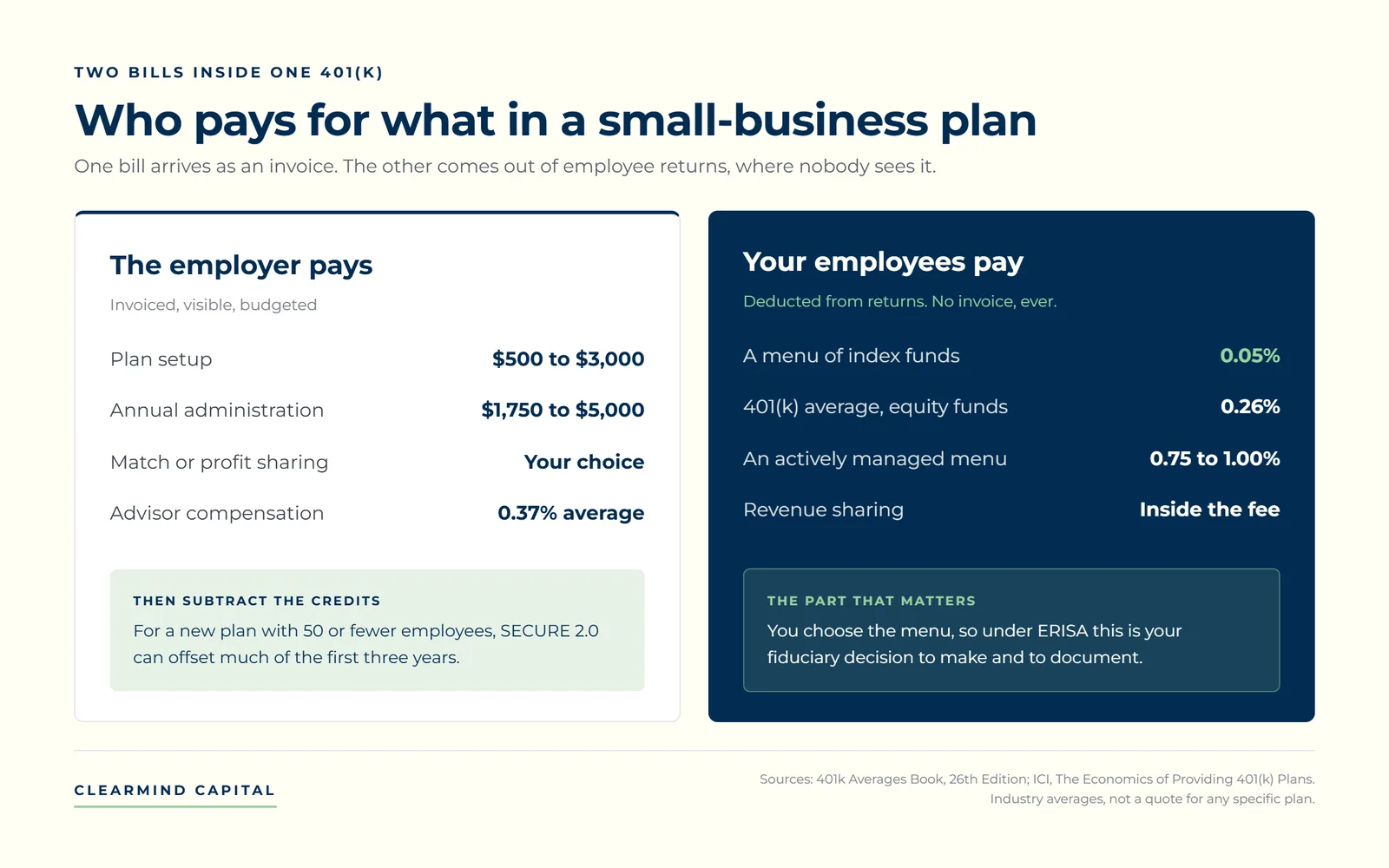
Every 401(k) has two bills. One goes to the company. The other comes out of your employees' account balances, every year, without ever appearing on a statement anybody reads. And the company chooses how big that second one is.
Bill one: what you pay
Getting it started. Usually $500 to $5,000, depending on how the plan is designed and who you partner with.
Running it every year. Usually $1,750 to $5,000 for a small plan. That buys the annual compliance test, the recordkeeping, the government filing, the required notices, and somebody for your employees to call. Some providers charge a base fee plus a per-person amount, which matters as you hire. Yes... this can all get confusing quick because it really is personalized to the company.
What you put in for employees. A match, a safe harbor contribution, profit sharing, or some mix. This is usually the biggest line, and it is deductible by the business, same as payroll. Knowing your maximum annual outflow is key before committing to any structure... and it's not too "terrible" to ballpark it.
For example, many business owners elect the safe harbor employee contribution method.
Safe harbor plans come in two main forms. The non-elective version means you contribute 3% of every eligible employee's salary regardless of whether they put anything in themselves. If you have 10 employees averaging $60,000, that's $1,800 per person — $18,000 out of the business per year, full stop. The match version works differently: you only contribute for employees who actually participate, typically 100% of the first 3% they put in plus 50% of the next 2%, maxing out at 4% for employees contributing at least 5% of their salary. If participation is low, the match version usually costs less. Either way, safe harbor contributions vest immediately — employees own them on day one, which matters when you are thinking through total compensation.
The non-elective gives you a predictable budget. The match version gives you a lower ceiling if participation is modest. Running the math on both against your actual headcount and salary profile tells you which one fits.
The advisor. Sometimes billed to the company, sometimes charged against plan assets, sometimes a bit of both. Market-wide, advisor compensation on a $5 million plan averages about 0.37% of assets, roughly $18,500. On a $50 million plan, it averages 0.16%. Small plans pay a higher rate for similar work, which is worth knowing when you evaluate what you are getting.
Then subtract the credits, which for a new plan are substantial. A business with 50 or fewer employees can get 100% of qualified startup costs covered up to $5,000 a year for three years, plus $500 a year for automatic enrollment, plus up to $1,000 per employee earning under $100,000 for contributions you make. Should Your Business Start a 401(k)
... you still here? Okay phew... thought I lost ya.
Bill two: what your employees pay
Every fund in the plan menu charges an annual fee called an Glossary of Financial ClarityExpense ratioThe yearly slice a fund takes off the top, shown as a percent. It looks tiny at 0.5%, but it gets charged every single year for decades, so it compounds against you. Cheaper funds leave more of the growth in your pocket.General education only. Not tax or investment advice. See the full glossary. It is not deducted from anyone's paycheck, and it does not show up as a transaction. It comes out of the return before the return reaches the participant, which is precisely why it can go unexamined for a decade.
Some scale, from Investment Company Institute research:
| Where the money sits | Typical annual cost |
|---|---|
| Index equity mutual funds | 0.05% |
| What 401(k) participants paid on average for equity funds | 0.26% |
| Target date funds, where most default money sits | 0.29% |
| A menu leaning on proprietary or actively managed funds | 0.75% to 1.00% |
A fund charging 1.00% costs a participant twenty times what one charging 0.05% costs for similar market exposure.
There is also a term worth knowing, because it explains a lot of otherwise confusing pricing: revenue sharing. Some funds send a slice of their expense ratio back to the recordkeeper or the advisor to cover plan services. The effect is a plan that looks cheap on the employer's invoice, because the participants are funding the services out of their returns instead. It is disclosed, it is legal, and it is most common in exactly the small-plan market where owners are least likely to have heard the phrase.
The number that tends to get people's attention
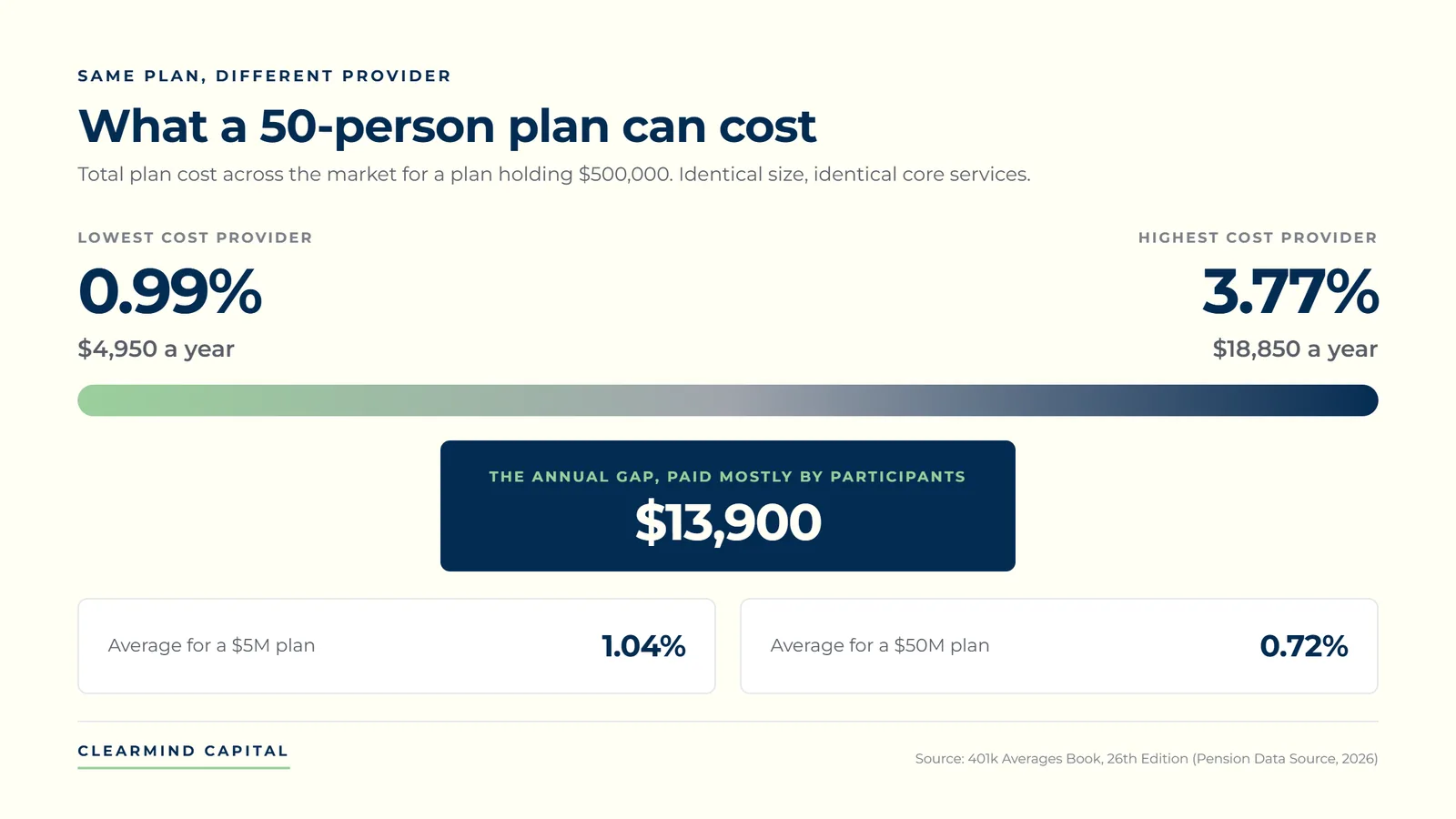
The 401k Averages Book has benchmarked plan costs since 1995. In its latest edition, a 50-participant plan holding $500,000 shows total plan costs ranging from 0.99% to 3.77%.
A spread of nearly three percentage points a year! That is a wide range.
In dollars on that $500k plan, the low end runs about $4,950 a year and the high end about $18,850. This is why we encourage plan reviews because many business owners chose a provider once, several years ago, probably on a recommendation, and never had a reason to look again. Do you know what you are paying?
For broader context: a $5 million plan averages 1.04% in total cost, and a $50 million plan averages 0.72%. Scale helps and it definitely explains part of the gap. Still... 3.77% versus 0.99% at identical size. That part is provider selection and plan design.
Who is responsible for which part
Sponsoring a plan makes you a Glossary of Financial ClarityFiduciarySomeone legally required to put your interests ahead of their own paycheck. Sounds like the bare minimum, and yet a lot of the financial world doesn't work that way. When an advisor is a fiduciary, “is this good for me or good for them” has a clearer answer.General education only. Not tax or investment advice. Read the full story under federal law. That sounds heavier than it usually feels in practice, and it comes down to four things you should be able to show you did:
- Compare the plan's total cost against similar alternatives on some regular schedule
- Review the investment menu against a written standard and swap out what fails it
- Give employees a real chance to understand the plan and their choices
- Keep a record that you did the first three
Heavy emphasis on the last one. A sound process you cannot document looks the same from the outside as no process at all.
Two arrangements move some of this off your plate. A 3(38) investment manager takes discretion over choosing and monitoring the fund lineup, and takes the fiduciary responsibility for those decisions with it. A 3(21) co-fiduciary advises and shares the responsibility while you keep the final say. Either way, you still have to monitor whoever you partner with, but that is just the nature of the beast.
How to find your number
Ask your provider for one figure: total plan cost as a percentage of assets, with recordkeeping, administration, advisor compensation, and the weighted average fund expense ratio all rolled in. Then ask how much of it participants pay.
You are legally entitled to this. Department of Labor rules require service providers to disclose their compensation to you, and the information arrives in documents that are technically complete and practically unreadable. Any decent provider can produce the summary number within a day or two if you ask plainly.
If it turns out your plan is priced well, you have a document for the file and one less thing to wonder about. If it turns out it is not, you now know something worth knowing. A benchmarking review takes a few weeks, does not interrupt payroll, and does not obligate you to change anything. Is that worth it to you?
Happy to run one if you want a second set of eyes. Is Your Company 401(k) Any Good
Common questions
How much does a 401(k) cost per employee?
Employer administration costs on a small plan typically run $1,750 to $5,000 a year total, which, spread across 25 employees, is roughly $70 to $200 each. Separately, employees pay investment costs through fund expense ratios, which for a well-built menu run about 0.05% to 0.25% of their balances annually.
Who pays 401(k) fees, the employer or the employee?
Both, in different ways. Employers typically pay setup, administration, and any contributions they make. Employees pay the investment costs embedded in each fund's expense ratio. Advisor compensation and recordkeeping can be charged to either, depending on how the plan is arranged.
What is a reasonable total 401(k) plan cost?
Benchmarks vary by plan size. A $5 million plan averages about 1.04% in total cost and a $50 million plan about 0.72%, per the 401k Averages Book. Smaller plans run higher. What matters most is comparing your plan against others of similar size rather than against a single national figure.
What is revenue sharing in a 401(k)?
An arrangement where a portion of a fund's expense ratio is paid back to the plan's recordkeeper or advisor to cover services. It reduces what appears on the employer's invoice by shifting the cost into participant returns. It must be disclosed and is most common among smaller plans.
What is the difference between a 3(21) and a 3(38) fiduciary?
A 3(21) co-fiduciary advises on investment selection and shares responsibility while the employer retains final decision-making authority. A 3(38) investment manager takes discretion over selecting and monitoring investments and assumes fiduciary responsibility for those decisions. The employer keeps a duty to prudently select and monitor either one.

 Written byAustin Wolfe & Joe AndersonClearMind Capital · Workplace RetirementView bio →
- 401k Averages Book, 26th Edition (Pension Data Source, 2026): total plan cost ranges, advisor compensation averages, and plan-size benchmarks.
- Investment Company Institute, The Economics of Providing 401(k) Plans: Services, Fees, and Expenses, and Trends in the Expenses and Fees of Funds, 2025, published March 2026.
- SECURE 2.0 Act of 2022, sections 102 and 111; IRS Instructions for Form 8881, revised December 2025.
- ERISA sections 3(21), 3(38), and 404(a); Department of Labor service provider disclosure rule, 29 CFR 2550.408b-2.
The information presented in this article is for informational purposes and should not be intended as tax, accounting or legal advice, nor is it an offer or solicitation to buy or sell, or as an endorsement of any company, security, fund, or other offering. Please consult your legal, tax, or accounting professional regarding your specific situation. Investments involve risk and have the potential for complete loss. It should not be assumed that any recommendations made will necessarily be profitable.
The opinions expressed in any commentary posted on this site are solely those of the individual author and do not necessarily reflect the views or opinions of ClearMind Capital, LLC. These opinions are based on information available at the time of posting and are subject to change without notice. ClearMind Capital, LLC, does not commit to updating any posted positions or commentary to reflect subsequent developments. While the information and reasoning used to form these opinions are believed to be from reliable sources, ClearMind Capital, LLC, does not verify this information, and no guarantee is provided regarding its accuracy, completeness, or validity. ClearMind Capital, LLC, disclaims any and all liability for actions taken or not taken based on the content of this site. No warranty, express or implied, is given in connection with the content provided.
Certified Financial Planner Board of Standards Center for Financial Planning, Inc. owns and licenses the certification marks CFP®, CERTIFIED FINANCIAL PLANNER®, and CFP® (with plaque design) in the United States to Certified Financial Planner Board of Standards, Inc., which authorizes individuals who successfully complete the organization’s initial and ongoing certification requirements to use the certification marks.