
If you’ve been investing for the last decade, it’s been easy to feel like the S&P 500 is the only place that matters.
Buy the S&P 500 (like VOO). Hold it. You look smart.
And for many new investors, it’s a great place to start. But as your wealth grows and your net worth increases, diversification begins to matter more.
U.S. stocks have been the main character for a long time. International has felt like the supporting actor who keeps getting written out of the script.
Then the script changed.
In 2025, developed international stocks (MSCI World ex-USA) returned about 21.1% (net total return), while the S&P 500 total return was about 17.9%. That’s roughly a 3.2% advantage for international in a single year — something we haven’t seen in quite a while.
Owning both the U.S. and international beat owning only the S&P 500.
For many investors, that was a brand-new experience.
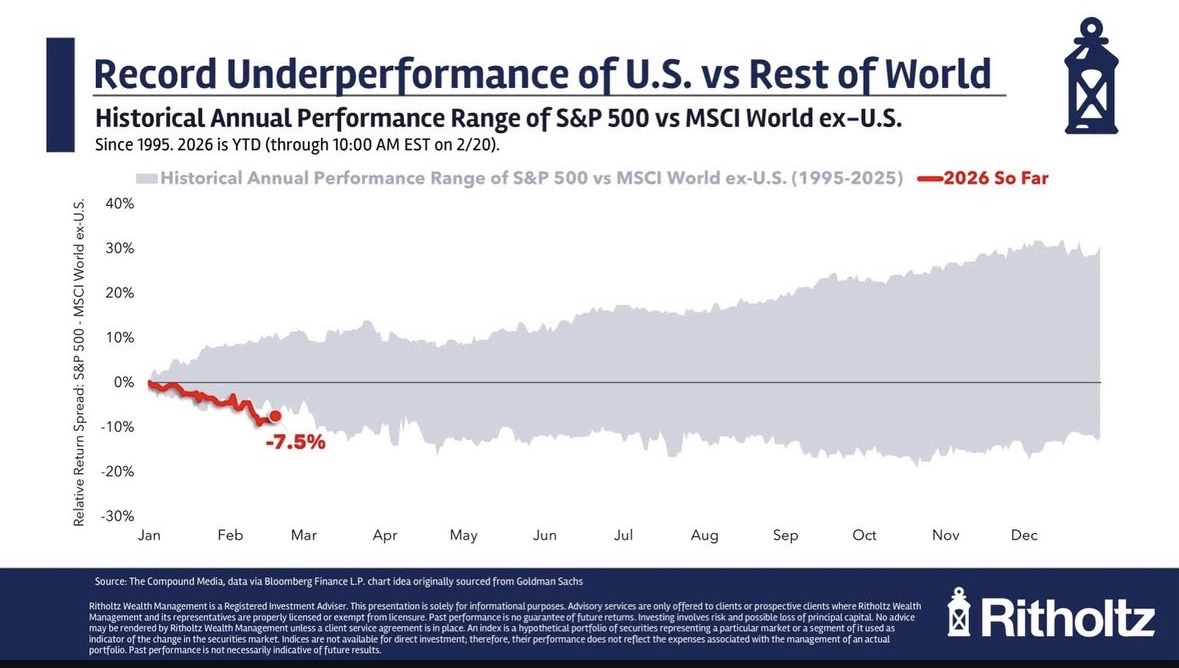
And here's a quick look at how it's going so far in 2026:
Recency Bias is Undefeated
Most people don’t wake up one day and say, “I’d like to be accidentally concentrated.”
It happens slowly:
You own some international. It lags. You trim it. You add more U.S. because it’s working. Then one day you look up and realize your “diversified” portfolio is basically VOO with a passport.
This is normal behavior. Your brain associates familiarity with safety, and markets quietly punish that instinct.
I talk a lot about how our brains trick us… especially in this arena.
Cycles Are Normal (but they last a long time)
Leadership between U.S. and international markets has gone back and forth for decades:
Late 1980s — international strong Late 1990s — U.S. dominates 2003–2007 — international leads 2010–2023 — U.S. dominates again Now — rotation beginning
Ben Carlson at A Wealth of Common Sense described 2025 as one of the largest relative outperformance years for developed international stocks in decades.
Here’s the key point: cycles last long enough that people forget they’re cycles.
I can barely remember what I ate last Tuesday, so expecting investors to remember market history from 2003 is… ambitious.
But this isn’t new, and if only there were signs… Oh wait. Just look at this chart:
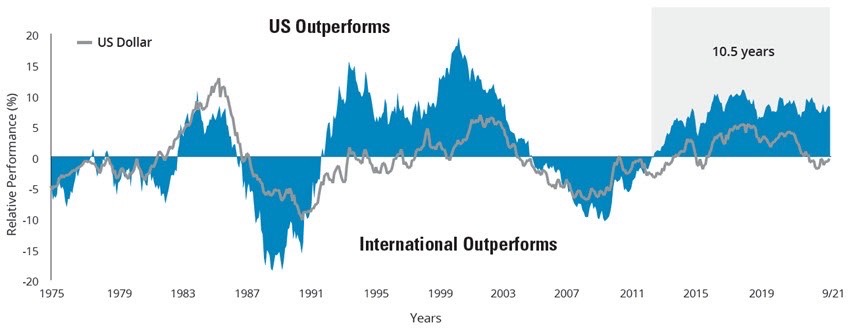
I will never advocate market timing, but many people have been pointing out international valuations for years. Last year didn’t come out of nowhere.
What was maybe more surprising was this happening under the Trump administration. Good lesson there: the market doesn’t give a s**t.
Why It Flips
I won’t get into all the boring details of why it flips all of a sudden… okay, maybe a few:
- Valuations
One market gets expensive after a long run. Another stays cheaper. Over time the gap narrows.
- Currency
A weaker U.S. dollar boosts returns on foreign investments when translated back to dollars. The dollar declined meaningfully in 2025 and helped international returns.
- Breadth
The S&P 500 has been heavily driven by a small group of mega-cap companies. International markets are structured differently. When performance broadens globally, they participate more.
Individually, these are small forces, but together they matter.
Diversification Finally Had It's Moment
Diversification isn’t a performance flex. It’s risk management that keeps a long-term plan intact.
A diversified portfolio will always own something that looks wrong for a while. That’s the admission price.
The real risk shows up when a portfolio relies too heavily on a single winner (has anyone checked on Bitcoin?)
And that pain tends to arrive at the worst possible times:
• right before retirement • during a job change • when distributions begin • when you need stability, not excitement
What This Means (and what it doesn't)
This isn’t a call to abandon U.S. stocks. The U.S. remains one of the strongest, most innovative economies in the world and will continue to be a core holding.
This is also not a forecast that international will now dominate for a decade. It’s a reminder:
Different parts of the world take turns leading.
If you own a globally diversified portfolio, you should expect long stretches where one sleeve looks pointless. That’s just how markets function.
Practical Takeaways
- If your portfolio is 95% U.S. because “that’s what works,” you’re concentrated. It may work for a long time. Concentration just increases the chance it hurts at the wrong time.
- If you bailed on international after years of underperformance, you did what most investors do. You’re not alone. You were also probably late.
- If you stayed diversified, don’t celebrate outperformance. Celebrate that you didn’t have to predict anything for the plan to hold up. Cough cough... that’s the job.
Final Thoughts
Diversification is rarely exciting.
It does not win internet arguments (and your diversification video isn’t going viral anytime soon…lol).
It does not produce great cocktail-party stories.
BUT: It quietly reduces the number of things that must go perfectly for a financial plan to succeed.
Every so often the market reminds investors why it exists. 2025 was one of those reminders.
Thanks for being here. Until next time.
Sources • MSCI World ex USA Index fact sheet (2025 annual return) • S&P 500 annual total returns (2025) • U.S. Dollar index movement 2025 — Reuters economic reporting • Historical relative performance studies summarized by Ben Carlson, A Wealth of Common Sense

The information presented in this article is for informational purposes and should not be intended as tax, accounting or legal advice, nor is it an offer or solicitation to buy or sell, or as an endorsement of any company, security, fund, or other offering. Please consult your legal, tax, or accounting professional regarding your specific situation. Investments involve risk and have the potential for complete loss. It should not be assumed that any recommendations made will necessarily be profitable.
The opinions expressed in any commentary posted on this site are solely those of the individual author and do not necessarily reflect the views or opinions of ClearMind Capital, LLC. These opinions are based on information available at the time of posting and are subject to change without notice. ClearMind Capital, LLC, does not commit to updating any posted positions or commentary to reflect subsequent developments. While the information and reasoning used to form these opinions are believed to be from reliable sources, ClearMind Capital, LLC, does not verify this information, and no guarantee is provided regarding its accuracy, completeness, or validity. ClearMind Capital, LLC, disclaims any and all liability for actions taken or not taken based on the content of this site. No warranty, express or implied, is given in connection with the content provided.
Certified Financial Planner Board of Standards Center for Financial Planning, Inc. owns and licenses the certification marks CFP®, CERTIFIED FINANCIAL PLANNER®, and CFP® (with plaque design) in the United States to Certified Financial Planner Board of Standards, Inc., which authorizes individuals who successfully complete the organization’s initial and ongoing certification requirements to use the certification marks.
